
We Always Believed Sport Builds More Than Fitness. Now We Have the Data to Start Proving It.
At Sportz Village Foundation, we believe sport can be more than a game for young people throughout the country, across communities – it can be a strong pathway to employability, whether that path leads to a career in sport or beyond it. Our hypothesis is simple: engaging with sport builds the foundational social-emotional skills – communication, collaboration, critical thinking, creativity – that shape how young people perform in the classroom, the workplace, and in life itself.
This belief sits at the heart of our Employability Through Sports initiative, an ongoing effort to help young people from underserved communities build the skills and opportunities to pursue both sporting and non-sporting careers.
This Phase 1 report is our first proof point in testing that hypothesis.
PHASE 1: THE STARTING LINE
Every game and training session asks young people to communicate, collaborate, adapt and solve problems under pressure. We’ve seen this play out across thousands of youths – this pilot set out to measure it.
In partnership with mySATHI and Career Launcher, we assessed 78 young people from Sportz Village Foundation programs on four future-ready competencies – Communication, Collaboration, Critical Thinking and Creativity, known as the 4Cs. With its AI-powered future-readiness and employability assessment platform, mySATHI measured how young people apply the 4Cs to real-world situations through structured, scenario-based tasks.
The assessment ran over three days across two NGO partners in New Seemapuri, New Delhi. All participants came from lower-income households, in communities where opportunities to develop and measure these skills are rare.
What We Found
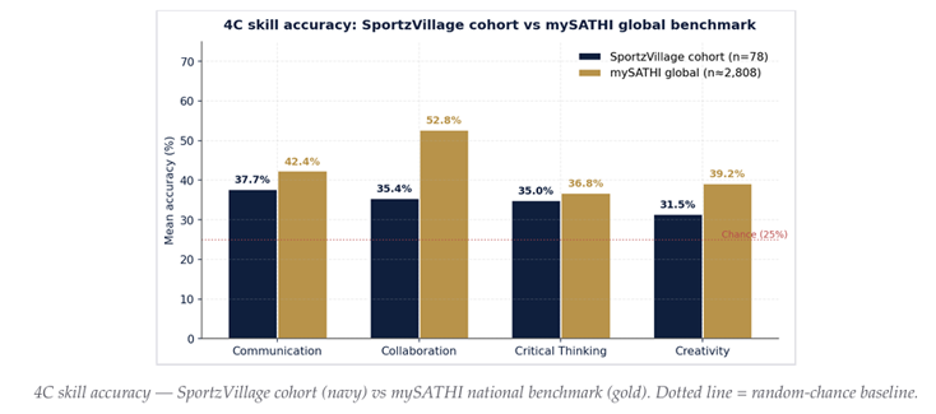
86% of participants demonstrated performance above the random-guessing baseline across all four competencies – a strong first signal that these skills are genuinely present in this group.
Looking at how that holds up against national data: Critical Thinking matched the benchmark set by nearly 2,800 learners assessed across India, and Communication came within 5 percentage points of it – the tightest gap of any skill measured. That young people from underserved communities, with far fewer resources for structured skill-building, scored at par or near a much broader national cohort is an early but meaningful signal for our sports employability hypothesis: sport itself may be the resource closing that gap.
“We went into this pilot hoping to find a small signal somewhere. What we found instead was a cohort that matched a national benchmark on critical thinking, and came very close on other parameters, highlighting the potential that has always existed when given the right support.”
– Parminder Gill, Co-Founder & Head of Foundation, Sportz Village

What Comes Next
This baseline is just the beginning. Each child now has an individual profile across the 4Cs – a launchpad for deliberate development, not just a score, and a building block in our sports employability pathway. Two things follow: children will be re-assessed at regular intervals to track growth, and the next phase will add personality and aptitude assessments to build a fuller diagnostic – one that feeds into an individual development plan for each child, geared toward both sporting and non-sporting career pathways.
Why This Matters Beyond Us
As AI reshapes the workplace, employers increasingly differentiate talent by human capabilities – communication, collaboration, creativity, critical thinking – not technical knowledge alone. Sport offers a natural, everyday environment for building exactly these skills, and that convergence is also where this pilot connects to the direction of India’s National Education Policy.
This has relevance well beyond grassroots sport. The same 4Cs measured here are what high-performance training environments already work to build alongside technical excellence.
It also speaks to a harder truth: for every young athlete who turns professional, many more fall away from the game with little to show for the years invested, and no clear path forward. By identifying the skills a child has already built through sport, we can spot that potential early – and act on it long before a sporting career is decided one way or the other, opening a path toward non-sporting careers as well.
Understanding the Findings Responsibly
Our next step is to build a comparison study that helps us understand precisely how much of this impact sport itself drives – alongside the role of partner support and each participant’s own motivation. We believe the strongest evidence comes from asking honest questions, and we’re excited to keep building that picture over the coming phases, as we work to validate our sports employability hypothesis at scale.
Moving Forward
This assessment is an important milestone – but only the beginning. We look forward to working with partners, educators, and supporters who believe in the transformative power of sport.
“This Phase 1 report is just the starting point. As we move into a longitudinal study — layering in personality and aptitude assessments alongside the 4Cs – we will be able to build individual development plans for these children, not just measure them once a year. Our belief is simple: sport should never force a child to choose between the field and the classroom. When we can show, year on year, that young athletes are also strengthening the cognitive and personality skills that academics and employers value, sport and academics stop competing for a child’s future and start reinforcing it.”
— Sujatha Kshirsagar, President, Career Launcher | mySATHI
Together, we can build a future where every young person has the confidence, skills and leadership to succeed – on the field and beyond.