
During the pandemic, many children lost access to schools, playgrounds and regular physical education. Digital programmes helped some children stay active, but not every household had access to stable internet, devices or adult support.
To address this gap, Sportz Village Foundation, supported by DXC Technology, piloted Race Around India—an offline, non-digital physical education intervention that helped children engage in structured physical activity safely from home.
The programme was implemented across Tamil Nadu and Bangalore and was designed as a team-based race that combined movement, learning and friendly competition.
Race Around India was created to make physical activity accessible even when children could not participate in digital learning programmes.Children participated from home by completing activities such as sprinting, running, skipping, cycling, climbing stairs, spot jogging, jumping jacks and push-ups.
The programme used a simple game format where teams competed against each other by completing activities and earning points.
The pilot included five competing groups, with each group consisting of approximately 32 to 40 children.The programme ran for around 10 weeks, or approximately 2 to 2.5 months. During this period, each child completed an average of 60 activities.
The race was designed around ten city stages. Teams began their journey in Bangalore, travelled through major Indian cities and returned to Bangalore at the end of the race.
The cities included:
Children were divided into four teams:
Each child received a workbook linked to their team colour.
The workbook included:
The aim was for every team member to participate. The team that completed the race first, after all members had completed their activities, was declared the winner.
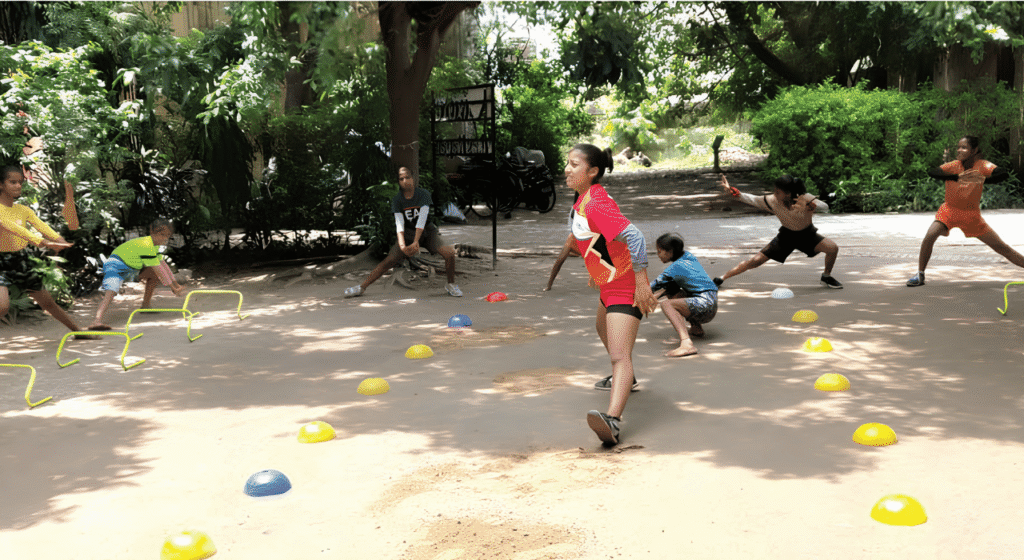
The programme used activities that children could perform within or around their homes and communities.
These included:
This format made the programme flexible, practical and accessible for children with different levels of space, equipment and support.
The programme recorded 100% participation among children who took part in the race.
The activities were designed to help children strengthen key fitness areas:
Race Around India gave children opportunities to practise important social-emotional skills.
Children learned to:
The programme also built in gender-sensitive practices, including appointing female witnesses for female participants.
Beyond physical activity, Race Around India introduced children to India’s geography, cultural diversity, languages and historical context through its city-based workbook.
The programme showed that learning and physical education can continue even without digital access, when activities are designed to be inclusive, engaging and easy to use at home.